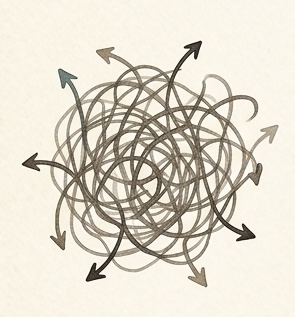
Educators make decisions about behavior every day, often with limited time and incomplete information. A student may be confused, protecting status, avoiding a task, responding to stress, testing a boundary, seeking connection, or making a deliberate choice. More than one of those things may be true.
More than one of those things may be true.
Different educational frameworks help adults notice different parts of the same moment. None gives us complete knowledge of a student, and none removes the need for professional judgment. Together, they can widen the questions we ask before deciding what to do.
Introduction
Relationships before response
Relationships are foundational, transformative, and a significant protective factor for young people. They are built in ordinary moments: greeting a student, remembering something they shared, noticing a strength, following up after an absence, laughing together, or asking what music, movie, game, color, or place matters to them.
The particular question matters less than whether the interest is real. Students often recognize when an adult is working through a relationship-building checklist. Genuine curiosity cannot be reduced to a script or used as a strategy for securing later compliance.
Adults do not need to share every student’s interests. They do need to communicate that the student is worth knowing beyond grades, attendance, behavior, and the last difficult interaction.
A relationship may increase trust without producing immediate cooperation. Its value does not disappear when a student struggles, disagrees, refuses, or makes a mistake.
Positive community develops when these relationships reinforce one another. It is not simply a collection of friendly interactions.
Students experience school through more than their relationships with individual adults. They experience how adults work together, how peers treat one another, how authority is used, whether routines are predictable, whether expectations are accessible, and what happens after someone makes a mistake.
Adult–student relationships influence whether correction, support, and accountability can be heard. Adult–adult relationships influence whether students encounter coordinated support or conflicting and escalating responses. Peer relationships shape status, belonging, conflict, influence, and the social risks attached to accepting help or changing course.
Students also develop a relationship with the school environment itself. Classrooms, hallways, offices, routines, and discipline processes can become associated with safety and membership—or with unpredictability, exclusion, and humiliation.
Positive community develops when these relationships reinforce one another. It is not simply a collection of friendly interactions. It includes dependable adults, meaningful student membership, constructive peer norms, accessible expectations, fair processes, and credible ways to repair and return.
Introduction
Foundational questions
What do students learn about relationships from the way adults work together?
When and where do students experience genuine interest outside correction?
Which framework most strongly shapes your school’s current response to behavior?
Which questions disappear when adults feel pressure?
Where does your system rely on consequences without enough teaching?
Where might relational language be used without enough clarity or accountability?
What happens to a student’s relationship with school after something goes wrong?
What would it mean to respond for growth instead of trying to win the moment?
We all bring background noise into the room. Notice it, find the moment again, and respond for growth—not for the win.
— Hoy
Part I · The Strategy
When the moment turns
A student refuses a reasonable direction. A correction becomes public. Frustration rises while the rest of the class watches. The expectation still matters, but pressing harder may make it less likely that the student can hear it. In that moment, the adult is teaching more than the rule. Tone, timing, audience, and the next available choice all shape what happens next.
Difficult moments rarely call for a speech. They call for judgment: whether to address the behavior now or later, whether to speak privately, whether the student is ready to reflect, and what support or accountability will help. A useful response protects safety and dignity without losing sight of the expectation.
A boundary may need to be held, and a consequence may be required. Even then, the student needs a workable next step and a way back to participation. When harm has occurred, the work also includes understanding the impact and taking part in repair.
Read the moment
No strategy works for every student or every situation. What helps depends on regulation, development, culture, access, the relationship already in the room, and what safety or school procedure requires.
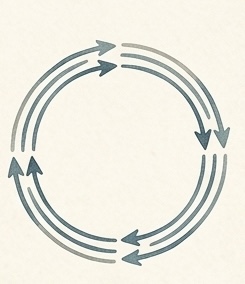
The five phases are Prevent, Pause, Pivot, Repair, and Return. They are not a fixed timeline. A moment may move quickly, stall, circle back, or require another adult. The phases help an educator decide what kind of response the moment can hold.
When an adult response misses the mark, naming the impact, making a repair, and restoring participation can model the same skills the framework asks students to practice.
Part I · The Five Principles
The Five Principles
The phases help answer when and what: what the moment can hold and what kind of response is most useful now. The Five Principles shape how that response is carried out without losing dignity, relationship, accountability, or a way back. Neither is a script; the work still depends on the student, the setting, professional judgment, and school procedures.
Principle 01
The Audience Effect
A larger audience can raise the social stakes. When possible, reduce the audience before making the ask.
Peer context can strongly shape how a classroom interaction unfolds, especially when a correction becomes public. A student may be responding both to the original request and to the social stakes of being corrected in front of others.
Adolescence gives peer context particular weight. Public identity, belonging, and status are still being worked out, and a correction delivered before peers can become a second problem layered over the first.
Correcting from the front of the room → correcting from beside the desk.
A public correction can turn a small request—put the phone away—into a test of status: comply in front of everyone or risk looking weak. Proximity, a lowered voice, a private aside, or a pre-agreed signal can preserve the expectation while lowering the social stakes.
Say
[walk over, quiet, beside them] “Phone in the bin for ten minutes, then it’s yours. Thanks.”
Skip
[across the room] “Jordan! I have asked you THREE times to put that phone away!”
Instead of this, try this
“Put your phone away NOW.” → quiet, by name, with a time limit and a thank-you
Correcting from the front of the room → correcting from beside the desk
Making an example of one student → keeping that student from becoming an example
Watch for
The audience may be one important peer, not the whole class. A quiet correction can still carry shame if the tone is sarcastic. Tone travels.
In practice
Third period. Maya has her phone out again. Instead of calling across the room, you move closer and say quietly, “The phone still needs to be away. Put it in the bin for now, or check in with me at the door.” Maya may comply, ask for another option, or refuse. The private approach does not settle the outcome; it addresses the expectation without turning her into an example.
Try this
For one class period, move corrections to a private channel when it is safe and feasible. Notice student responses, exceptions, and what you may want to adjust.
Principle 02
The Dignity Principle
Preserve dignity while holding the expectation. A short-term response should not unnecessarily damage the relationship needed for future work.
Dignity is a person’s inherent worth. It is not earned and it is not conditional on behavior. Respect may change with conduct; dignity does not.
That distinction is the whole principle. A student’s behavior may need correction. The student’s dignity is never the thing on the table.
Public shaming, sarcasm, or a power move may produce short-term compliance while damaging trust. An adult can be correct about the behavior and still respond in a way that makes future cooperation and repair harder.
Say
“You’re better than this moment. Let’s fix it. I’ll help.”
Skip
“Maybe if you actually did your work instead of clowning around...”
Instead of this, try this
“Act your age.” → “This one’s hard. Let’s take it one step.”
A consequence that humiliates → a consequence that corrects and preserves face
Assuming the worst → extending benefit of the doubt
Watch for
Benefit of the doubt may be especially difficult to maintain when an adult is tired, rushed, or reacting strongly. Notice when an interpretation hardens quickly, and pause long enough to consider what else may be true.
In practice
Devon flips his worksheet onto the floor and mutters that it is stupid. The room waits. You avoid sarcasm and say quietly, “This one looks frustrating. Pick it up, and I can help you start the first problem.” Devon may accept, need another option, or continue to refuse. The response keeps the expectation visible while offering support and reducing the chance that the interaction becomes a public contest.
Try this
Before settling on a consequence, ask: Is it proportionate? Is it connected to the behavior or harm? Does it preserve dignity and leave a path back? Where you have discretion, adjust the response when one of those pieces is missing.
Principle 03
The Escalation Ladder
Behavior escalates when adults and students compete for control. Step off the ladder; don’t climb it.
Adult and student responses can interact in ways that increase or decrease intensity. Pay attention to timing. A response that may help early in an interaction may add pressure once the situation has escalated.
Adults may experience these behaviors as bait.
Acceleration may include an eye-roll, a refusal, a challenge, or a visible increase in intensity. Adults may experience these behaviors as bait; naming their own reaction can help them avoid turning the moment into a contest.
Raising one’s voice, stacking consequences, or issuing ultimatums may add intensity. Acknowledging, allowing appropriate time and space, seeking support, or returning later can create better conditions for de-escalation. Safety needs and school protocol still govern the response.
Say
“I’m going to give you a minute. I’ll be right back.” [step away, lower voice]
Skip
“Excuse me? You do NOT get to talk to me like that. That’s a referral.”
Instead of this, try this
Matching the student’s volume → lowering your own
Adding consequences mid-climb → pausing all consequences until recovery
“Last warning!” ultimatums → time and space, then a calm return
Watch for
Peak intensity is primarily a safety moment. Save nonurgent teaching, reflection, and consequence conversations for recovery.
In practice
“You can’t make me.” The words may pull an adult toward an argument. When safety and supervision allow, one response is to step back, lower the voice, and say, “I’m going to give this a little space. I’ll check back.” If the pressure does not ease, follow the appropriate school support or response.
Try this
When the bait arrives, name it silently. That’s acceleration. Then answer one rung lower than the student, not one rung higher.
Principle 04
The Reentry Principle
Whenever possible, a consequence should include a clear path back to participation, learning, and belonging.
A consequence responds to what happened. Reentry addresses what participation, repair, and support look like next.
When a consequence has no clear path back, a student may experience continued exclusion or uncertainty about belonging. That can make repair and future participation harder.
Accountability remains; belonging does too.
Reentry is a deliberate return after removal, de-escalation, absence, or another difficult moment. It may be a brief welcome and orientation or a fuller plan. Accountability remains; belonging does too.
Say
“Glad you’re back. Clean slate. Here’s where we are, jump in right here.”
Skip
[student returns; teacher says nothing and avoids eye contact the rest of the period]
Instead of this, try this
Silent treatment after an incident → a brief, genuine welcome and clear next step
“We’ll see if you’ve changed.” → “Clean slate. Here’s where we are.”
A consequence with no path back → a consequence plus a named way home
Watch for
Cold reentry. Technically allowing the student back while withholding warmth reads to the student as continued exile. The tone is the message.
In practice
Aaliyah returns from the office after a difficult interaction. At the door you say, “Glad you’re back. We’re on page 12. Start here, and I’ll check in with you shortly.” She may be ready to join, or she may need a different first step. The reentry language communicates that the earlier incident will be addressed through the appropriate process without making continued exclusion the price of returning.
Try this
Prepare reentry language before you need it. Use it promptly when the student returns, adapting to readiness and context. Reconnect, orient, and offer a manageable next step.
Principle 05
The Relationship Bank Account
Withdrawals require deposits. Build the relationship before you need it.
The Relationship Bank Account adapts Stephen Covey’s metaphor: some interactions build trust and connection, while others place strain on the relationship. Greetings, specific noticing, fairness, curiosity, and follow-through can build relational capital. Correction and accountability may draw on it, but the metaphor should not turn relationships into transactions or praise into currency for compliance.
The same correction can land differently depending on trust, history, fairness, timing, and the student’s experience of the adult. Relationship does not guarantee cooperation. It changes the context in which feedback is heard.
Specific acknowledgment tells a student what the adult noticed—for example, “Thanks for getting started.” It should remain authentic, culturally responsive, and sensitive to student preference; praise is not experienced in the same way by every student.
Say
[at the door, by name] “Morning, Sam. Good to see you. Loved your point yesterday.”
Skip
[first words to a student all day are a correction, before any deposit has been made]
Instead of this, try this
First interaction of the day is a correction → first interaction is a greeting
“Good job.” → “Thanks for starting the second you sat down.”
One big repair gesture → many small, consistent deposits
Watch for
An overdrawn account cannot be fixed with one big deposit. It is rebuilt with many small, consistent ones. Repair is steady, not dramatic.
In practice
Across the week, you have greeted Marcus, noticed his drawing, thanked him for starting, and shared a moment of humor. When he drifts off task, you say quietly, “Marcus, back with me.” The correction arrives within a history that includes more than correction. Marcus may still resist, but he knows this is not the only way you see him.
Try this
For one period, tally specific supportive interactions and corrections. Notice the balance, authenticity, and distribution across students, then choose one adjustment to try.
Part II · Connecting Frameworks
The shared center
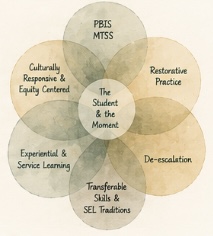
Most schools already use more than one approach to behavior, relationships, and school climate. The crosswalk translates points of connection while preserving the history, purpose, language, and practice expectations of each approach.
The central overlap is among three established traditions: trauma-informed practice, restorative practice, and PBIS. They are not interchangeable, and each keeps its own history, purpose, training, and expectations for practice.
The crosswalk below names these connections without pretending that a brief handbook can reproduce the full practice behind any of them.
Trauma-informed practice contributes attention to safety, trust, regulation, and the conditions needed for learning. Restorative practice contributes attention to belonging, impact, accountability, repair, and return. PBIS contributes structure: expectations taught explicitly, prevention, acknowledgment, and graduated support.
At the shared center, Prevent, Pause, Pivot, Repair, and Return organize the adult response across the moment. The Five Principles keep attention on audience, dignity, escalation, reentry, and relationship. The school’s existing approaches remain the methods behind the shared language.
Part III · The Consequence Continuum
Accountability is developmental
Accountability involves skills that develop over time. Access to those skills changes with regulation, context, trust, communication, development, and the situation itself.
School discipline often treats accountability as binary: a student admits what happened, apologizes, and accepts the response—or is judged unwilling. That structure can miss the student’s present readiness and the skills or conditions needed for honest reflection.
A student may be protecting status, managing shame, questioning fairness, responding to stress, or struggling with perspective-taking or communication. Pressure for immediate accountability can produce a rehearsed apology, withdrawal, argument, or greater distress. None of those responses tells the whole story of the student’s eventual capacity for accountability.
Read the moment, not the person
The Continuum is a way to notice a student’s readiness in a particular moment. It is not a student label.
A student’s position may change across incidents, relationships, settings, and points in the same conversation.
The adult is looking for more than an admission. The work may include helping the student regulate, hearing what happened, separating intent from impact, teaching perspective-taking, and keeping enough relationship intact for repair to remain possible.
Look for the next workable movement toward reflection, responsibility, repair, or reentry. Aim one readiness step forward rather than demanding the final stage immediately. Sometimes that step is simply space, support, a private check-in, or an agreement to return to the conversation.
The expectation does not move; the staircase becomes reachable.
A consequence can establish a boundary, protect safety, or meet a school requirement. Learning asks what happens next: reflection, repair, support, and return. The expectation may stay fixed while the route and timing change.
Part III · The Five Stages
The five stages
The Continuum describes five possible positions of accountability readiness. It reads the moment, not the person. A student’s position may change across incidents, relationships, settings, and points in the same conversation.
Audience can change readiness
A student who reflects privately may become defensive around peers when the social stakes rise. Describe what is observable now rather than turning the stage into a trait.
1
Avoiding or not yet engaging
May sound like
“It wasn’t me.” “This is dumb.” Silence, walking away, laughing it off.
Regulate before reason. Lower the stakes, delay the debrief, signal the relationship is intact.
Possible next step
Co-regulation, time, a private check-in. The incident conversation may need to wait.
2
Beginning to engage
May sound like
“Okay, but they started it.” “It was just a joke.”
What may be involved
Partial accountability. Testing whether the process is fair before investing in it.
Educator consideration
Affective statements. Acknowledge their piece of the truth. Introduce intent against impact.
Possible next step
A structured reflection sheet. Naming impact without confessing motive.
3
Acknowledging
May sound like
“Yeah, I did that.” Accountable for the act, no plan yet.
What may be involved
Accountability has landed but the path forward is foggy. Shame can set in here.
Educator consideration
Restorative questions. Who was affected, what needs to happen to make it right.
Possible next step
Further restorative questions or, when appropriate, choosing a repair option.
4
Considering or beginning repair
May sound like
“What can I do to fix it?”
What may be involved
Motivated for action. Needs a concrete, dignified path.
Educator consideration
Contribution-based repair tied to the harm. Co-author the plan, do not assign it.
Possible next step
Carrying out repair with light support. Brief progress check-ins.
5
Reentering and carrying learning forward
May sound like
“Here’s how I’ll show up next time.”
What may be involved
Integration. The learning is becoming part of identity, not just this incident.
Educator consideration
Reentry plan. Restore role and status publicly. Log the Bank Account deposit.
Possible next step
Closing the loop, strengthening reentry, or taking a constructive role when freely chosen and developmentally appropriate.
Three field notes
Readiness is situational. Do not place a stage in a student record as though it were a trait. Audience can change readiness. An apology is not a complete measure of understanding; listen for specificity, perspective, and follow-through while accounting for language, disability, culture, communication style, and readiness.
The principle check
Audience Effect: reduce social stakes. Dignity: do not use humiliation or forced disclosure. Escalation Ladder: prioritize safety and regulation. Reentry: plan a workable return. Relationship Bank Account: trust and interaction history influence how accountability language may land.
Part III · Reflection
Intent, impact, accountability
Intent and impact are different parts of the same event. Accountability makes room to understand intent without using it to erase impact.
Owning impact does not require a student to accept a negative identity. Fear, shame, misunderstanding, distrust, communication needs, disagreement about the event, or concern about consequences may all shape resistance.
Shame aimed at the whole person often leads to hiding, defending, or shutting down.
Keep the conversation focused on the behavior and its impact. Shame aimed at the whole person often leads to hiding, defending, or shutting down. A student is more able to consider repair when the person is not treated as the problem.
The reflection sheet separates intent from impact. One side asks what the student was trying to do, get, avoid, or protect.
One side asks what the student was trying to do, get, avoid, or protect. The other asks who was affected and how the event may have been experienced. Some students can begin with intent and then consider impact. Others need a different format, communication support, more time, or more than one conversation.
Questions that can move reflection forward
“Walk me through what you were trying to do.”
“If the other person described this, what might they say happened?”
“What would make this closer to right?”
“What do you want people to see from you next time?”
The Impact Web
Learning impact through mapping
A full web may take time. During a busy school day, an educator may use a brief conversational version to open reflection and identify a next step. That conversation does not by itself complete a restorative process.
Use and limits
Do not force an admission, apology, direct contact, reconciliation, or repair meeting. What happens next still depends on readiness, consent, safety, power, developmental needs, and school-based protocols.
A full Impact Web
Write or draw what happened in the center.
Ask who may have been affected or may still be carrying part of this. Add a branch only when a person, group, relationship, shared space, or part of self emerges.
From each branch, ask how the impact may be showing up. Mark uncertainty rather than turning possibility into fact.
Ask what might help make the situation more right, safer, or more workable. Record possibilities, not promises.
Decide what needs more information, whose voice is missing, what support is needed, and what readiness or protocol step comes next.
Conversational version
“Here is what happened. Who is feeling the effects? How might it be showing up for them? Where are we now? What would a better next point look like? What is one move that could help us get there?”
A quick map opens reflection and identifies a next step; it does not stand in for a completed repair process.
Part IV · Practical Language and Tools
Language to adapt, not scripts to perform
Try these as starting points, not formulas. Different words will work for different people, relationships, cultures, communication needs, and situations. Educators and students should rewrite them into language they can say honestly.
Restorative language
Possible openings, questions, and structures for community-building, repair, and reentry. Serious harm, safety concerns, and complex conferences require appropriate school protocols and trained support.
Family and guardian language
Possible openings for first contact, good news, difficult information, partnership, attendance, access, and follow-through.
Say It Better · for students
Starting points for boundaries, pressure, conflict, help-seeking, strong feelings, and online situations. Unsafe moments are get-an-adult moments.
Repair readiness
A planning conversation for deciding whether the people, timing, supports, and format are ready for a restorative next step. It is not a score or label.
Restorative questions
What happened?
What was happening for you then? What are you thinking about now?
Who has been affected, and how?
What might help address the impact or move this closer to right?
Full Part IV
The print handbook contains the complete restorative, family/guardian, and student-facing language pages, plus the Repair Readiness and Learning Reflection.
Part V · Youth Partnership and Applied Repair
Learning through rehearsal and shared work
A scene makes a response visible. Rehearsal lets students and adults pause at a decision point, notice what raised the pressure, try another move, and compare what changes. The learning is in examining choices, not performing a perfect script.
Meaningful youth partnership requires real choices about the issue, language, roles, audience, format, revision, and whether a piece should be performed at all. Adults still carry responsibility for safety, access, accurate information, school protocols, and follow-through.
Four commitments
Choice
Participation, role selection, personal disclosure, and performance boundaries are discussed rather than assumed.
Dignity
No student or group becomes a stereotype, cautionary tale, villain, diagnosis, or public example.
Accuracy
Health and prevention claims are checked against current authoritative sources and localized carefully.
Support
Adults plan for disclosures, accessibility, language needs, emotional activation, mandated reporting, and a clear route to help.
Keep the roles clear
Educational role-play is not an actual restorative process. A performance cannot establish facts, secure consent, make an agreement, or complete repair for real people.
Substance-misuse prevention can use the same rehearsal structures alongside—not in place of—health education, counseling, prevention work, and school or community supports.
Part VI · Strategy Index and Quick Reference
Strategy Index and Quick Reference
Use this index to find the part of the handbook that matches the work in front of you.
A difficult moment is beginning
Start with Part I: the five phases and Five Principles.
You need language for a conversation
Go to Part IV: restorative, family, and student-facing language.
A student is not ready to reflect
Use Part III: the Consequence Continuum and conversation case.
A consequence needs a learning purpose
Use contribution-based repair and the Repair-to-Transfer cycle in Part III.
You need to understand impact
Use the Impact Web, intent-and-impact sheet, or conversational version.
A student is returning
Use the Reentry Principle, reentry plan, and accountability conversation frame.
Peers or adults are preparing for repair
Check readiness first. Use the facilitator readiness tool when the repair is complex or could cause more harm.
Students are rehearsing prevention or repair
Use Part V and the Youth Partnership Toolkit.
You are planning professional learning
Use the Facilitator Guide and the Learning and Assessment packet.
Part VII · Learning and Assessment
Practice, application, and follow-up
Detailed quizzes, application responses, answer keys, practice trackers, rubrics, and completion records are in the separate Learning and Assessment Packet. The larger purpose is transfer: noticing a real situation, selecting a proportionate response, trying it, studying what happened, and adjusting the next attempt.
Connect
Name a real situation and what makes it difficult.
Understand
Examine the idea, evidence, boundaries, and school context.
Experience + Practice
See or participate in a model, then rehearse language and decisions with feedback.
Apply + Plan
Use one move in an authentic setting, identify what to notice, and return to the attempt later to adjust.
Assessment is not a readiness label
Knowledge checks are for educator learning. The Consequence Continuum and Repair Readiness and Learning Reflection are not tests to score students, diagnose character, compel an apology, or force direct repair.
Teach It Better does not issue credentials. Contact hours, continuing education, or recertification credit are determined by the school, district, provider, or licensing body.